


If someone asked, “Who manages one of an organization’s largest assets—and one of its biggest operating budgets?” the answer in many businesses would be the Facilities / Operations team.
The difference between a professional organization and one that is costly and breakdown-prone is simple:
A professional organization does not treat FM as “just fixing failures.” It treats it as an integrated organizational function connected to business objectives.
According to IFMA (adopting the ISO definition), Facility Management is an organizational function that integrates people, place, and process within the built environment to improve quality of life and the productivity of the core business.
That definition matters because:
FM is not only about equipment. It also includes user experience, safety, service continuity, and productivity.
FM creates value when it is designed in alignment with organizational objectives—not when it operates purely in a reactive mode.
In practice, FM is typically split into two domains.
Hard FM includes services related to building/site infrastructure and physical components, such as:
Mechanical and electrical systems (HVAC, power distribution, generators, UPS, elevators, etc.)
Utility networks (water, wastewater, steam, compressed air, fire protection systems)
Building fabric maintenance, façade, grounds, and site infrastructure
Soft FM includes services that support occupants and shape experience and day-to-day operations, such as:
Cleaning, support services, security, access control
Reception and general services, waste management, welfare services
Managing service contracts and contractor performance
A key point for the Iranian market: Many organizations take Hard FM seriously but underestimate Soft FM as “simple services.” In reality, Soft FM has a direct impact on user satisfaction, productivity, brand perception, and HSE risk exposure.
Maintenance is one of the most important components of FM, but FM is broader than maintenance.
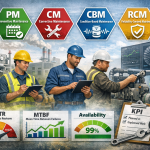
Maintenance focuses on asset health: PM/CM programs, spare parts, MTTR/MTBF, and reducing failures.
FM includes maintenance plus service quality, SLAs, space/workplace performance, contractor governance, user experience, sustainability, and business alignment.
In hospitals, malls, hotels, and factories, FM means delivering stable service to the user and the core process—not only “keeping equipment running.”
FM and physical asset management deliver the best results when they work together.
Institute of Asset Management defines asset management as balancing costs, opportunities, and risks against desired asset performance to achieve organizational objectives. It also cites ISO 55000’s definition: asset management is the coordinated activity of an organization to realize value from assets.
In practical terms:
FM focuses on delivering built-environment services and daily operations.
Physical Asset Management focuses on lifecycle decisions—from asset creation to operation, optimization, renewal, and disposal.
In a mature model, FM becomes the execution arm that delivers value across the lifecycle, while asset management becomes the decision and optimization framework for investment, risk, and lifecycle cost.
One of the best ways to design FM roles, processes, and KPIs is to use competency frameworks. IFMA introduces 11 core competency areas, including:
Project Management; Leadership & Strategy; Operations & Maintenance; Finance & Business; Sustainability; Communication; Occupancy & Human Factors; Performance & Quality; Facility Information & Technology Management; Real Estate; Risk Management.
Because they match real search intent:
“maintenance KPIs”
“facility services SLA”
“building energy management”
“smart facility monitoring / CMMS / CAFM”
“facility risk management and business continuity”
When your content and services are built around these pillars, search visibility improves—and your value proposition becomes clearer.
ISO 41001 is a requirements standard for a Facilities Management Management System. It defines system requirements so an organization can:
deliver FM effectively and efficiently in support of organizational objectives,
consistently meet stakeholder needs and applicable requirements,
and remain sustainable in a competitive environment.
According to International Organization for Standardization, ISO 41001 is non-sector-specific and can be used by all organizations (public or private), regardless of size or geographic location.
ISO 41001 also has a 2024 Amendment focused on climate action–related changes, reinforcing sustainability and energy as core FM priorities.
ISO 41011 is the FM vocabulary standard. The 2017 edition was withdrawn and a new 2024 version is available.
Practical benefit: when you use terminology in contracts, SLAs, procedures, and reports, you create a standard shared language that reduces ambiguity and improves auditability.
Many teams treat ISO as a “documentation binder.” But management standards are intended to change how work is decided and executed.
A facilities management system means:
scope and stakeholders are defined,
FM services are connected to business objectives,
risks, opportunities, and resources are managed,
performance is measured, and continual improvement is embedded.
This is exactly what ISO 41001 expects: demonstrating effective and efficient FM delivery, aligned to stakeholder needs and applicable requirements.
This is a real-world path (not a slogan) that can be adapted for offices, hospitals, commercial properties, or industrial sites.
Who receives FM services—executives, operations, patients, students, tenants? Clarify what they value: availability, comfort, safety, uptime, speed.
Which sites/buildings? Which services (Hard/Soft)? What is outsourced vs in-house?
Define each FM service like a product: description, hours/shifts, service level, owner, interfaces, KPIs.
Focus on measurable outcomes:
response and resolution time
PM compliance
repeat-failure rate
customer satisfaction (CSAT)
cost per m² and energy performance indicators
Minimum set:
work order management
preventive maintenance planning and scheduling
contractor management and performance review
spares and warehouse management
change management for small operational projects
HSE procedures tied to operations
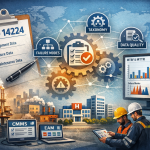
FM tech creates value only if:
asset coding is correct
asset hierarchy is realistic
histories are complete and reporting-ready
Map critical assets to service-impact scenarios (safety, uptime, business impact) and define controls.
Create competency matrices aligned to the IFMA domains and train by role.
Turn metrics into decisions: cost drivers, SLA gaps, top risks, improvement projects.
The goal is not “documents.” The goal is a repeatable improvement engine that demonstrates effective and efficient FM delivery.
Treating FM as maintenance only → design SLAs and user-experience measures.
KPIs without reliable data → fix asset hierarchy and work order discipline first.
Outsourcing without governance → monthly vendor scorecards and KPI-linked terms.
“Fake PM” → redesign PM tasks based on failure modes and measurable outcomes.
Ignoring energy and sustainability → align FM objectives with climate and energy priorities.
FM is the delivery of stable built-environment services with controlled cost, managed risk, and satisfied users—so core business productivity improves.
If you want to reduce operating cost, reduce repeat failures, control vendors via SLAs, and prepare for ISO 41001, we can help with:
FM system design, gap assessment, documentation, CMMS/CAFM implementation, operations training, and internal audits.
No. ISO 41001 can be applied to any organization or parts of an organization (public/private).
If you don’t have reliable asset data and work order discipline, start with process standardization plus CMMS—then complete the management system.
CMMS is more maintenance-focused. CAFM typically also covers space, services, building asset information, and broader integration.
PM compliance, response/resolution time, repeat-failure rate, user satisfaction, cost per m², and energy indicators.
Yes. FM is an organizational function. It can be delivered in-house, by contractors, or via a hybrid model.
Asset management guides lifecycle decisions based on cost/risk/performance; FM stabilizes day-to-day service delivery. Best results come from integration.
Yes. ISO 41011 is the FM vocabulary standard, with a new 2024 edition available.
Yes. A 2024 Amendment emphasizes climate action–related updates.